You will never finish anything - Lessons from a decade of mistakes
This time I’m not going to talk about technology here. In fact, I’m not going to talk about anything deterministic, my real goal with this post is to show how we can persist for a long time in something we think is correct, but that at the same time isn’t making us feel good.
This is a personal story that happened over several and several months. And also a story that I consider one of evolution, not just personal, but also professional. There is no script for this post, I don’t even know what I’m going to write about, I’m just sitting here typing what comes to my head and seeing how it turns out.
So follow me on this journey and, in the end, if you think you learned something, or if this text made you think about something in some way, please tag me on my Twitter (X?) and I would love to talk about it!
I was wrong#
In 2020, I published a series of articles on dev.to about personal organization. Back then I thought I had found the nirvana of personal organization, mastered everything there was to master about personal planning and productivity.
Until I realized that I was wrong, and how wrong I was…
It doesn’t mean that everything I wrote in that series of articles is completely unreal and untrue, in fact the principle I present in them is totally valid, I just thought that if I applied the same principle everywhere I would have more and more success, I would be more and more productive.
The peak of my “productivity addiction” came when I organized everything, planned everything, nothing stayed in my brain for more than 10 minutes without stopping in a to-do list or something like that, all my days were scripted, from beginning to end, I had times to wake up, hygiene, lunch, work, side projects, sleep and even to play something or have some leisure.
3 years later I realized that I was living on autopilot, it was as if I no longer had free will, and I myself created the prison that I locked myself into, and I didn’t even realize it.
I realized I was living on autopilot
The worst part of it all is that, back then, I preached this kind of productivity to other people as if I were some kind of evangelist, in other words, I was trying to teach other people to get trapped in the same prison that I was in. And today I’m here to tell you that no matter what you do, you will never have control of anything.
Control is an illusion#
No matter how much I planned my time, no matter how colorful my calendar was, why did I have the feeling that I wasn’t getting anywhere?
It took a long time before I realized that I had closed myself off in such strict planning that I spent more time planning my day than actually doing something useful. What we call planning paralysis, or analysis paralysis. It’s when you spend too much time thinking and analyzing everything to make it perfect before you start doing anything.
I thought I needed to master 100% of anything before I could even try to practice or do something. I never started any personal project, often about something important, because I needed to be sure of all the steps until I noticed that you really don’t need to know everything.
You don’t need to know everything to start
This became much more evident after I started my own TypeScript training, few people know, but I made at least about 6 previous versions of this same course or other courses before I even started doing anything. Until I started talking to friends and other people close to me and everyone told me: “You think too much, you need to stop thinking and start doing”.
That hit me very hard, because I always heard that throughout my life, that I planned things too much, that I was the type “thinker” (idealist) and not a “doer” (maker), and that “the world was full of ideas”, and what was I doing about it?
It’s not about getting it right the first time#
In the world of software development, choice paralysis is extremely common. So common that I basically educated my own brain to think that I was always living in a project planning phase.
I believed in that, I thought that you could only move to the next stage of anything once you had completely finished the previous stage. And this affected me in many areas, both in personal relationships and in my career.
At the beginning of your career, having this kind of mindset even helps you, because you’re more sure that you got everything right before moving to the next step and you only focus on one thing at a time. But even so, at the beginning of a career, devs only focus on a single project. As you progress, you stop being a person who is taking care of a single project, you start taking care of multiple ones, then people, then teams. And now I ask you:
Do you think you’re going to get it right the first time?
If you think yes, I have bad news for you. You need to manage your expectations. Because you won’t. You might even get it right once, but you’re never going to constantly get it right the first time, and that’s good, in fact it’s great.
Not getting it right the first time, but iterating over something that is “good enough” is better than doing it once and never going back to improve what was done.
I worked for years at a company where the CTO had a phrase that, at the time, I hated, but I think many people have already heard:
Done is better than perfect
Every time he said that to me I would get very angry internally. “How can he want me to do something poorly made and send it to people to use?”, that was my thought. But, the more time passed, the more I started to think that he was increasingly right.
Nobody cares, seriously…#
I’m going to use software development as an example, because that’s what I know how to do, but you as a dev will always think that you have to write the best code, the most performant, the most beautiful to be able to do something, create a feature.
While creating good code, that is easy to maintain in the long run and well documented, is indeed not only necessary, but mandatory (at least in my opinion). Your end users really don’t care if you wrote that if statement or not.
If you’re afraid, go ahead and be afraid
It took me 5 or 6 years to start understanding what he meant back then. But when I understood that it was never about poor code quality, but rather about the same thing that everyone had been telling me since I was little: just do it, then you see what happens.
It’s not about releasing code or a product that is knowingly bad, but rather releasing something, doing something, having something to show. It doesn’t matter if it’s still a bit rough, if it doesn’t have 100% test coverage, the important thing is that this thing stopped being a concept and became reality.
It was hard for me especially, being a neurodivergent person (a topic for another post), to accept this idea that you need to start, even if it’s imperfect. I’ve always been an extremely detail-oriented person, as I mentioned before, I could only move to the next part when the previous part was completely ready, perfect. But that was also an important lesson.
Nothing is ever done. It’s just good enough.
You will never finish anything#
Something that was even harder for me to understand, and I still don’t feel comfortable with this idea or the idea that I need to “just do it”, was the concept of “good enough”.
A friend once told me that he had seen (or read, I don’t remember) an interesting phrase in a software development book saying that: there are no finished projects, only projects that have been abandoned because they are “good enough”.
And then, researching a little more for this post (rant, maybe?) I discovered that the original phrase is, or at least we believe it is, from Leonardo Da Vinci, and it has to do, of course, with art.
Art is never finished, only abandoned
So we took the phrase and made a parallel with software development, and although I think it’s a bit presumptuous on our part, I still think it’s true that no type of project is, in reality, finished. And that’s because we don’t know the future.
Today I even read a really cool article that said that nobody was a senior engineer right off the bat, I’ll analyze that article another day, but, in the end, it says something that is very important:
We are always wrong. We will never be right, because products change, people change, everything changes.
And, just as people change, we also change, projects that were once important to us, or that were even useful, end up becoming things that we don’t see with the same eyes, that we abandon, but not because they are bad, simply because they were good enough, and now they’re not anymore.
Another interesting thing I noticed is that having consistency is better than having big spikes of development or growth. It’s better to grow slowly than to grow all at once. Addy Osmani is one of the people who constantly posts about this in small images on LinkedIn that I find super cool and motivational and they follow what is known as stoic mind, a variation of Stoicism. With images like that.
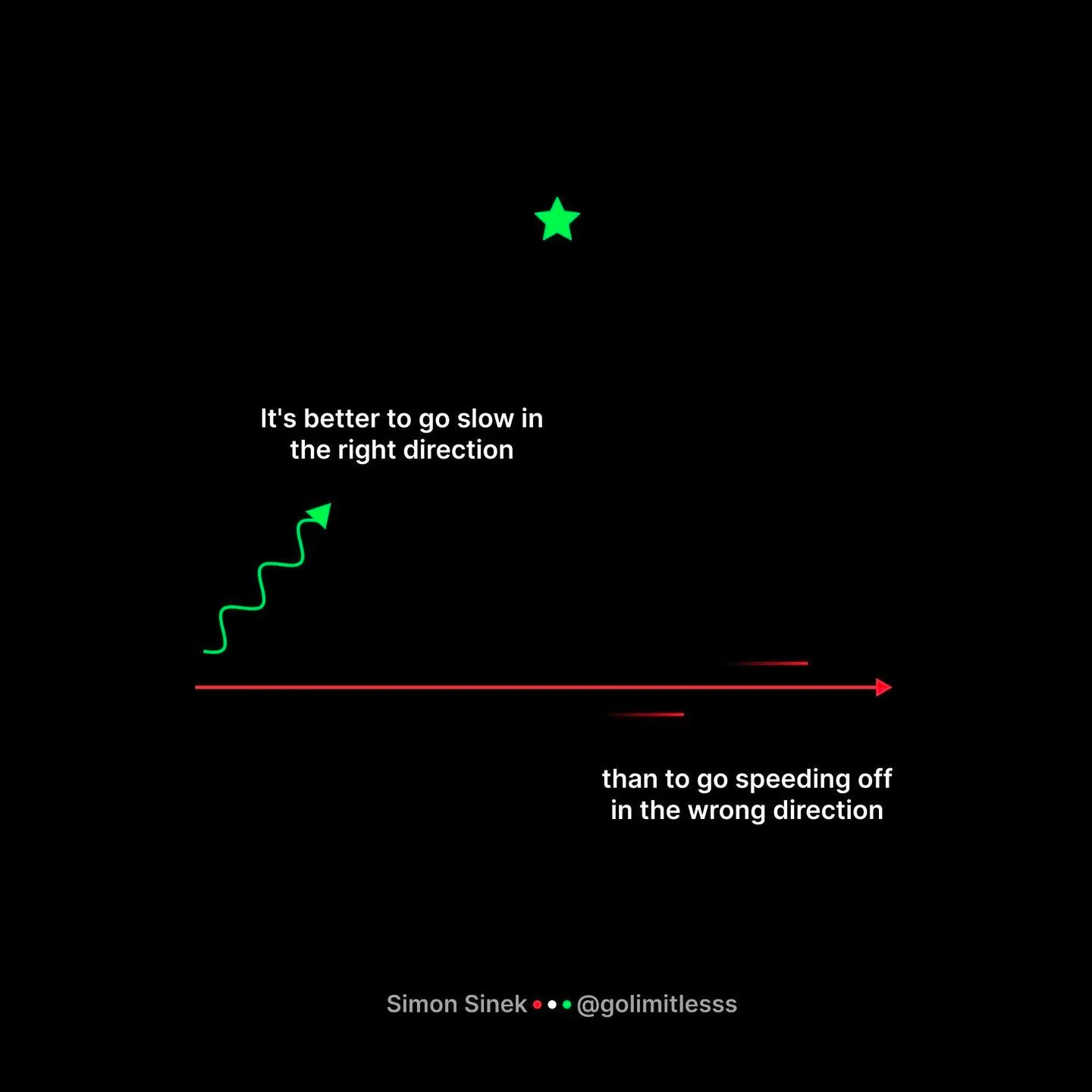
Warning. The messages are kind of “coachy”, so try to abstract the motivational part and focus on the message.
Embrace change#
The only constant we have in our lives is change, this might sound like hell, especially for those who have some kind of control syndrome, or even people like me, who exist only in environments that are in order, and have no other goal than to bring order to some kind of chaos.
Bad news for us, order never arrives.
Order never existed, nor will it ever exist
I learned that quite early on, understanding that I would never be able to control everything, as I said, control is just an illusion that we tell ourselves to calm our fears. I really like tattoos, so far I have 18 (and counting), the first tattoo I got was a discrete mathematical equation on my left wrist, but it became the most important thing to me.
In 1877 an Austrian physicist named Ludwig Boltzmann proposed an equation that would be used until today to define the “measure of disorder” in a system. There are the pragmatic and correct explanations of this equation, as well as the philosophical variations of it. One of the ones I like the most is:
Disorder is much more likely than order. Because there are simply many more disordered states than ordered states
And all of this is described in the equation S=KlogW, which is my tattoo, but why did I tell you this story?
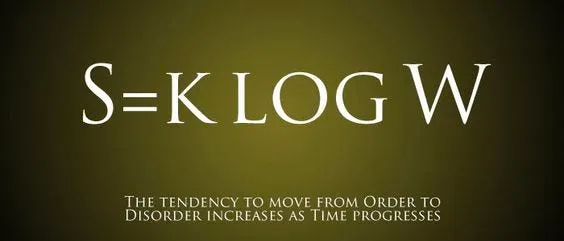
Some people have special items, others have specific thoughts, each one has their own anchor or beacon that they seek in moments of uncertainty, whether family, friends, addictions, books, games and so on. Mine is change.
I think that, regardless of everything that happens, change is the only constant that remains, disorder is the only thing left in the end, and it itself is in constant change. Therefore, any situation, no matter how complicated it may be, is just one of thousands of possible disorder states, that will eventually pass and disappear.
There is a certain beauty in change, a beauty that I myself was reluctant to accept until recently, even though I have change literally tattooed on my skin. I thought each problem was the last, that I always needed to get it right, and that’s not true. The important thing is the path, not the end, especially because there is no end.
The lesson#
I could write about this for days, but I think it’s time to wrap up this post. And, if I can choose one lesson for you to take from here, let it be that you will never have control, but that’s good, because that way you can change and improve more and more.
I don’t know if this will be a cool post that will help other people or not, but if you liked it, comment here and hit me up on my socials I’m really curious to know if anyone will even read or get some kind of insight from what I’m posting here.
Regardless, I hope you got something valuable from this reading, and I hope to write other articles like this in the future. And remember:
Done is better than perfect
Lucas.